
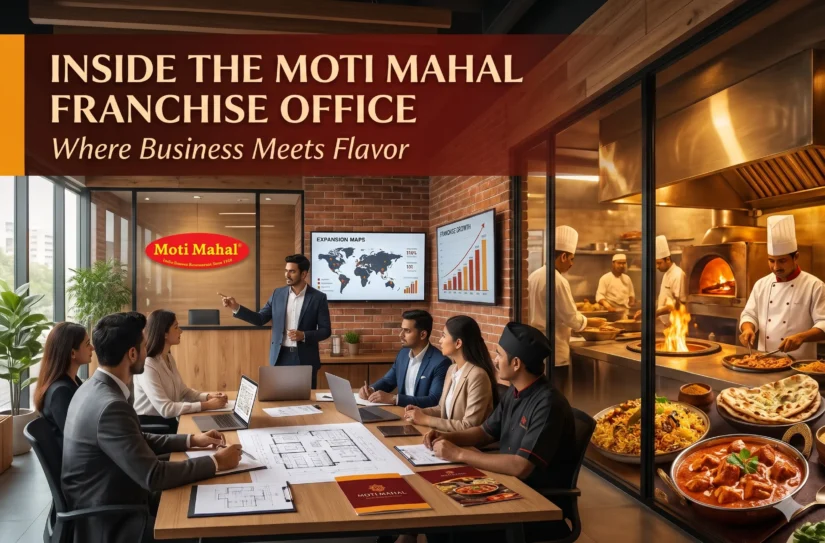
Inside the Moti Mahal Franchise Office
When people think about Moti Mahal, the first things that usually come to mind are Butter Chicken, Tandoori Chicken and Dal Makhani. These dishes have been part of India’s food culture for generations. But behind a restaurant serving these familiar flavours, there is a lot of planning and business work that most customers never get to see.
A restaurant does not open simply because someone has found a good location and decided to serve great food. There are discussions about the right restaurant format, investment, kitchen planning, equipment, staff, suppliers, food quality and customer expectations. Each decision has a role to play.
This is where the business side of Moti Mahal comes in.
The franchise office is where the conversation moves beyond food and into planning a restaurant business. An interested investor may want to understand the brand, explore a suitable outlet format, discuss a location or learn how the company-operated model works. The team needs to understand these requirements before the idea can move forward.
So, what happens behind the scenes when someone considers becoming a Moti Mahal franchise partner? Let’s take a closer look.
1. The First Conversation: Understanding the Investor’s Plans

Every franchise journey starts with an enquiry, but not every enquiry is the same.
One person may be looking to invest in a fine-dining restaurant. Another may have a commercial property and want to understand whether it can work as a food outlet. Someone else may be exploring the restaurant business for the first time and need a clearer picture of how the industry works.
The first conversation helps bring these requirements together.
At Moti Mahal, the franchise enquiry process gives interested people an opportunity to understand the brand and its business model. The discussion can cover the investor’s location, investment capability, business background and the kind of restaurant they are considering.
This is an important step because choosing a franchise should not be based only on how popular a brand is.
The business should also make sense for the investor’s plans and the market they want to enter.
For example, a location in a busy commercial area may have different customer requirements from a restaurant in a residential neighbourhood. The expected customer profile, available space and local competition can all influence the choice of outlet.
The idea is to understand these things before moving towards a final decision.
2. Understanding the Moti Mahal Brand and Its Different Concepts
Moti Mahal has a long association with North Indian cuisine and some of the dishes that helped introduce tandoori food to a wider audience.
But the restaurant business today is not limited to one type of dining experience.
Customers have different preferences. Some enjoy sitting down for a complete meal, while others prefer a quick lunch, takeaway or a casual food experience. A restaurant concept needs to consider these habits.
Moti Mahal’s franchise offering includes different food and restaurant concepts. Its official website features options such as:
- Moti Mahal: A restaurant concept associated with traditional North Indian cuisine and the brand’s signature dishes.
- Kebab Trail: A concept focused on kebabs, biryani, curries and related dishes.
- Food Truck Trail: A different format built around an accessible food experience.
- Express: A quick-service restaurant concept for customers looking for convenient meals.
- Chaat Trail: A concept centred on popular Indian street food.
- Dosa Trail: A South Indian food concept.
- Biryani Trail: A concept focused on regional biryani varieties.
- China Trail: A Pan-Asian food concept.
The available concepts and their suitability depend on the business opportunity being discussed.
This variety is worth understanding because a franchise investor should not select a format just because it sounds attractive. The concept needs to fit the property, local market, investment plan and expected customer base.
That is one of the important conversations that takes place before a restaurant plan moves ahead.
3. Location Planning: A Restaurant Needs the Right Neighbourhood

A good restaurant location is not necessarily the most expensive or busiest property in a city.
It is the location where the restaurant concept has a reasonable opportunity to find its customers.
For example, a fine-dining restaurant may need a different setting from an Express outlet. A restaurant near offices may experience different peak hours from one located in a residential area or shopping destination.
This is why location planning deserves attention before the final investment decision.
Moti Mahal’s published franchise process includes site identification and feasibility assessment. The company considers factors such as the proposed location, market potential and the suitability of the space for the selected concept.
Some of the practical questions involved in evaluating a location include:
- Is the area suitable for the proposed restaurant format?
- Who are the likely customers?
- Is the property easy to access?
- Is there enough space for the required kitchen and dining setup?
- What kind of restaurants are already operating nearby?
- Does the property meet the practical requirements of the concept?
These questions help build a clearer picture of the opportunity.
A restaurant may have an excellent menu, but if its location does not suit its target customers, attracting regular business can become difficult.
4. Turning an Empty Space Into a Restaurant
Once the location and concept have been discussed, the next part is planning the actual restaurant.
This is where food and business planning start coming together in a very practical way.
A restaurant kitchen needs to be designed around the menu. The equipment, storage areas, preparation sections and movement of kitchen staff all need to be considered. The dining area also needs to provide a comfortable experience for customers.
For a restaurant serving tandoori and North Indian food, kitchen planning is particularly important. Different cooking sections need suitable equipment and enough space for staff to work efficiently.
Moti Mahal’s franchise information includes concept planning, kitchen layout, interiors, equipment sourcing and other setup requirements.
The process may involve:
- Finalising the restaurant layout.
- Planning the kitchen and food preparation areas.
- Identifying the required equipment.
- Planning interiors and restaurant design.
- Coordinating the necessary hardware and software.
- Preparing the outlet for the next stage of operations.
These decisions are easier to manage when they are considered together rather than separately.
For example, changing the kitchen layout after equipment has been installed can lead to additional work and expense. Proper planning at the beginning can help avoid such problems.
5. The Food Side of the Business: Menu Planning and Kitchen Preparation

A restaurant franchise is ultimately judged by the experience it gives customers.
People may visit for the first time because they recognise the brand. They return when they enjoy the food and service.
For Moti Mahal, the menu is closely connected to its culinary history. Butter Chicken, Tandoori Chicken and Dal Makhani are among the dishes associated with the brand. Maintaining the expected taste and quality of such familiar dishes requires attention to ingredients, preparation and kitchen practices.
Menu planning is therefore not just about deciding which dishes will be served.
It also involves understanding how the menu will work in the selected restaurant format. The kitchen needs to be equipped for the dishes, staff need to understand their preparation, and the service team should know what they are offering to customers.
Moti Mahal’s franchise setup process includes menu planning, food trials and preparation for the opening.
Food trials are especially useful because they allow the team to check the menu before regular customers begin visiting. It is an opportunity to review preparation, presentation and the overall dining experience.
After all, a restaurant’s reputation is built through the food it serves every day.
6. Staff Recruitment and Training Before Opening
Even a well-planned restaurant needs the right people to bring it to life.
Chefs, kitchen assistants, service staff and managers all contribute to the customer experience. Their responsibilities may be different, but they need to work together.
Recruitment is therefore an important part of the preparation process.
Moti Mahal’s published franchise information includes staff hiring and training as part of the pre-opening stage. It also describes training for different kitchen sections, including tandoori and curry operations.
Training helps employees understand their work, food preparation expectations, hygiene practices and service responsibilities.
It is also important for the team to understand how the restaurant should function during busy hours. A restaurant may have a comfortable service flow when there are only a few tables occupied, but handling a full dining area requires coordination.
Getting the team ready before opening gives the restaurant a better starting point.
7. Technology and Operations: The Work Customers Don’t See

A restaurant may look simple from the customer’s side. They enter, place an order, enjoy their meal and leave.
Behind the scenes, however, several activities are happening at the same time.
Orders need to be recorded, ingredients need to be available, staff attendance needs to be monitored and daily operations need to follow the required processes.
This is where technology and operating systems become useful.
Moti Mahal’s franchise information mentions authorised software, automated systems, audit controls and remote performance monitoring as part of its operational approach.
These tools can help management review restaurant activity and identify areas that need attention.
For example, inventory records can help track stock movement. Sales reports can provide information about business performance. Audit systems can help review whether the required procedures are being followed.
Technology does not replace good restaurant management, but it can make information easier to access and decisions easier to review.
For franchise partners, this is an important part of understanding how the business will be managed after the restaurant opens.
8. The FOCO Hybrid Model: The Company Takes Care of Operations
One of the important parts of Moti Mahal’s franchise offering is its FOCO Hybrid model.
FOCO stands for Franchise Owned, Company Operated.
Under this arrangement, the franchise partner makes the investment and owns the outlet, while Moti Mahal’s team manages its operations as per the agreed terms.
This model is different from a traditional franchise arrangement where the franchisee is directly responsible for managing the restaurant every day.
Running a restaurant involves continuous work. Staff management, inventory, food quality, customer service and daily supervision all require attention.
With the FOCO Hybrid model, the company takes responsibility for managing the outlet’s day-to-day operations. This can be relevant for investors who want to participate in the restaurant business but do not want to personally handle every operational task.
The model is also an important part of the initial franchise discussion because investors need to understand how ownership and operations are divided.
The investment, management fees, responsibilities and financial arrangements should always be reviewed carefully before signing the agreement.
It is worth remembering that a company-operated model does not guarantee profits. The restaurant’s performance will still depend on its location, customer demand, costs and overall business conditions.
9. Brand Marketing and Local Marketing: Two Different Responsibilities

Opening a new restaurant is not just about getting the kitchen ready. People also need to know about the outlet.
However, marketing a restaurant brand and promoting one particular outlet are two different activities.
Brand marketing focuses on building awareness and recognition for Moti Mahal as a whole. This includes maintaining the brand’s identity and communicating what it represents to customers across different markets.
Moti Mahal handles its brand-level marketing activities.
Local and outlet-level marketing, on the other hand, focuses on connecting an individual restaurant with the people around it.
For this, Moti Mahal advises franchise partners on how they can promote their outlet in its local market.
This guidance may include understanding the neighbourhood, identifying potential customers, planning local promotions, exploring community partnerships and making use of local events.
For example, a restaurant located in a residential area may need a different local marketing approach from one situated in a commercial district.
The purpose is to help the outlet connect with its immediate audience while maintaining the larger Moti Mahal brand identity.
This distinction is important because a recognised brand can create initial interest, but local customers also need a reason to visit a particular restaurant.
10. What Happens After the Restaurant Opens?
The opening day is an important milestone, but it is not the end of the franchise journey.
Once the restaurant begins serving customers, the focus shifts to regular operations and maintaining standards.
There may be new challenges during the first few weeks. The team may need to adjust to customer traffic, improve service coordination or review inventory requirements. Customer feedback may also highlight areas that need attention.
Moti Mahal’s published franchise process describes post-launch activities such as quality audits, cost control, inventory management, regular reviews and operational monitoring.
These activities help keep track of how the restaurant is performing.
For example, regular reviews can help identify whether food costs need attention or whether a particular process is slowing down service. Quality checks can help ensure that the outlet continues to follow the expected standards.
The company also describes weekly virtual reviews and monthly audits as part of its post-launch operating process.
This is an important part of the FOCO Hybrid approach because the relationship between the franchise partner and the company continues after the restaurant becomes operational.
A restaurant is not a business that can simply be opened and left alone. It needs ongoing attention, review and improvement.
11. Business Meets Flavor: Why Both Sides Matter

There is an interesting balance in the restaurant business.
The customer sees the food, the service and the atmosphere. The business team sees the planning, investment, staffing, inventory, systems and costs that make the experience possible.
Both sides matter.
A restaurant with good food but poor operations can struggle. Similarly, a well-managed outlet still needs a menu and dining experience that customers enjoy.
Moti Mahal’s franchise approach brings these two sides together. Its culinary identity gives the restaurant its food heritage, while its franchise structure provides a process for planning, setting up and managing the business.
For someone considering a restaurant franchise, understanding this combination is important.
The decision should not be based only on the popularity of a dish or the history of a brand. It should also involve understanding the operating model, investment requirements, location suitability and responsibilities of both parties.
That is where a detailed franchise discussion becomes valuable.
Thinking About Starting a Restaurant Business With Moti Mahal?
A restaurant is built through many decisions, and most of them happen long before the first customer walks through the door.
From understanding the franchise model and selecting a location to planning the kitchen, preparing the menu and managing daily operations, every stage needs attention.
Moti Mahal offers franchise opportunities for entrepreneurs and investors who want to become part of its culinary legacy. Its franchise process includes initial discussions, location feasibility, restaurant setup, pre-opening preparation and ongoing operational management under its FOCO Hybrid model.
If you are considering entering the food and restaurant industry, you can explore the available franchise concepts and understand which option may suit your business plans.
Visit the official Moti Mahal website or explore the Moti Mahal franchise opportunity to learn more.
Have a location in mind or want to understand the franchise investment? Get in touch with the Moti Mahal team and start a conversation about becoming a franchise partner.
Frequently Asked Questions
The franchise process involves discussions about the brand, business model, investment, location, restaurant format and operational requirements. It helps interested investors understand the opportunity before moving ahead.
You can submit an enquiry through the official Moti Mahal website. The franchise team can then discuss your requirements and explain the available opportunities.
Moti Mahal’s website features several concepts, including Moti Mahal, Kebab Trail, Food Truck Trail, Express, Chaat Trail, Dosa Trail, Biryani Trail and other food formats. Availability and suitability should be confirmed with the company.
Yes. Location planning and site feasibility are included in the published franchise setup process. The suitability of a property depends on the restaurant format, market and other practical requirements.
Moti Mahal lists support for concept planning, kitchen layout, interiors, equipment sourcing and other setup requirements as part of its franchise process.
FOCO means Franchise Owned, Company Operated. Under this model, the franchise partner owns the investment while Moti Mahal’s team manages the restaurant’s operations according to the agreed arrangement.
Yes. The company’s published franchise information includes staff recruitment and structured training, including preparation for kitchen operations and service requirements.
Moti Mahal handles brand-level marketing to build awareness and recognition for the overall brand. The company advises franchise partners on local and outlet-level marketing so they can connect with customers in their area.
The published franchise process includes post-launch operational management, quality audits, inventory and cost control, performance reviews and ongoing monitoring.
The right format depends on your investment plans, proposed location, available space and target customers. You can discuss these details with the Moti Mahal franchise team before choosing a concept.
No restaurant franchise can guarantee profits. Business performance depends on factors such as location, customer demand, operating costs, investment and market conditions. Review the financial projections and franchise agreement carefully before investing.
Visit motimahal.in or the official franchise page for information about the brand, franchise concepts and enquiry process.
SEO Details
SEO Title: Inside the Moti Mahal Franchise Office: Where Business Meets Flavor
Meta Description: Take a look behind the scenes at Moti Mahal’s franchise process, from business planning and location selection to restaurant setup and operations.